
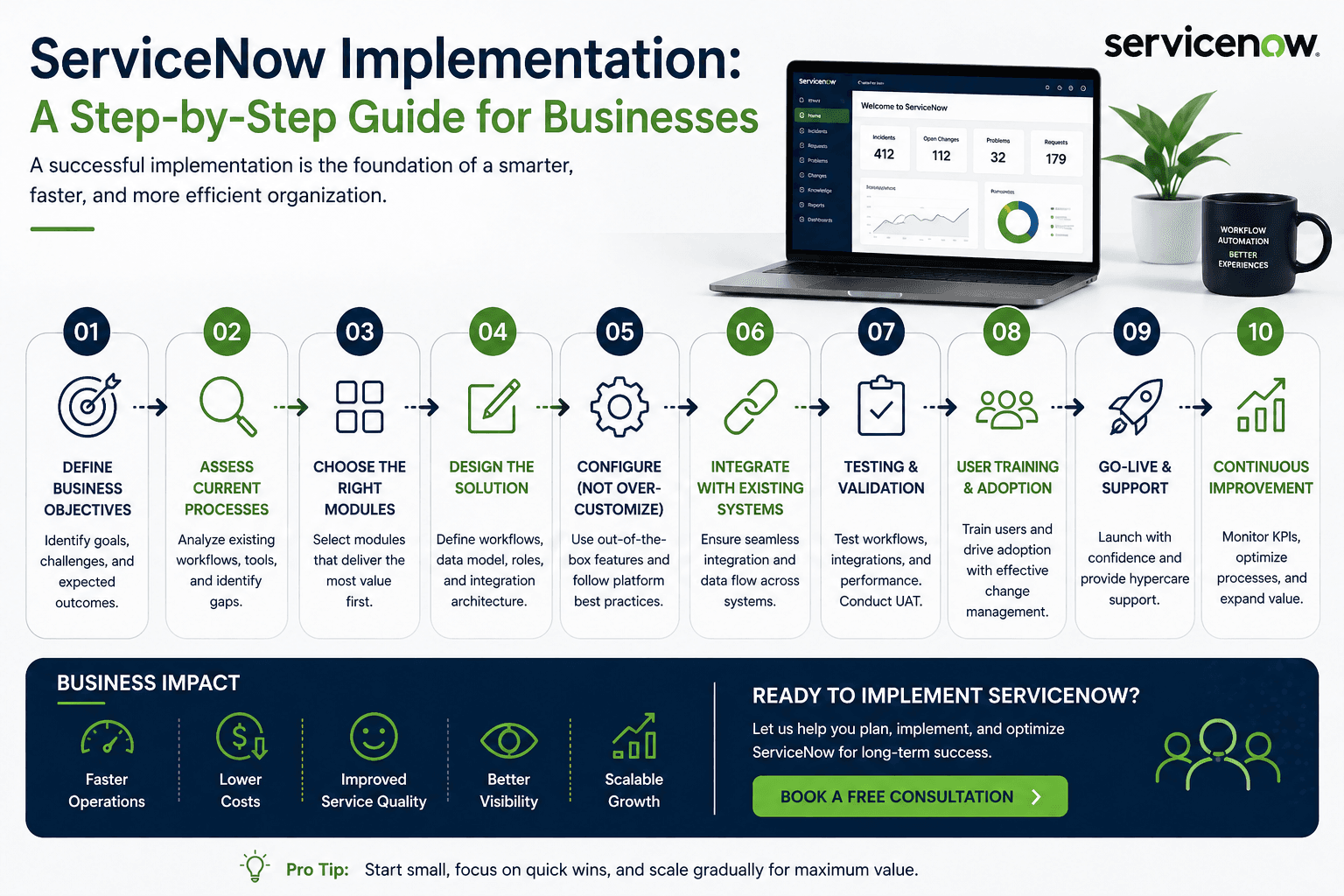
ServiceNow Implementation: A Step-by-Step Guide for Businesses


Learn how to successfully implement ServiceNow with this step-by-step guide covering planning, setup, customization, and optimization for long-term success.
🚀 Introduction
Implementing ServiceNow is more than just deploying a tool—it’s about transforming how your organization operates.
Many businesses invest in ServiceNow but fail to achieve full value due to poor planning, lack of strategy, or incorrect execution.
This guide walks you through a practical, step-by-step approach to ensure a successful implementation.
🧭 Step 1: Define Business Objectives
Before touching the platform, clearly define:
What problems are you solving? Which processes need improvement? What outcomes do you expect?
👉 Common goals:
Faster incident resolution Improved service delivery Workflow automation Cost reduction
Pro Tip: Avoid starting with technology—start with business outcomes.
🔍 Step 2: Assess Current Processes
Understand your current environment:
Existing tools and systems Manual processes and bottlenecks Integration requirements Data structure and quality
👉 This helps avoid replicating inefficient processes in ServiceNow.
🧱 Step 3: Choose the Right Modules
Start with what delivers immediate value:
ITSM → for IT operations ITOM → for infrastructure visibility CSM → for customer support HRSD → for employee workflows
👉 Don’t try to implement everything at once.
🏗️ Step 4: Design the Solution
This is where strategy matters.
Define:
Workflow design Data model User roles and permissions Integration architecture
👉 A well-designed solution reduces future rework.
⚙️ Step 5: Configure (Not Over-Customize)
ServiceNow is designed to be configured—not heavily customized.
Best practices:
Use out-of-the-box features where possible Avoid unnecessary custom code Follow platform standards
👉 Over-customization leads to upgrade and maintenance issues.
🔗 Step 6: Integrate with Existing Systems
Most organizations need integrations with:
ERP systems CRM platforms Monitoring tools Identity systems
👉 Ensure smooth data flow across systems for unified operations.
🧪 Step 7: Testing & Validation
Before going live:
Perform functional testing Validate workflows Test integrations Conduct user acceptance testing (UAT)
👉 Catch issues early to avoid production failures.
🎓 Step 8: User Training & Adoption
Even the best system fails without adoption.
Focus on:
Training sessions Documentation Change management Stakeholder communication
👉 Make it easy for users to adopt the platform.
🚀 Step 9: Go-Live & Support
During go-live:
Monitor system performance Provide real-time support Quickly resolve issues
👉 A smooth go-live builds confidence across the organization.
🔄 Step 10: Continuous Improvement
Implementation is just the beginning.
Post go-live:
Monitor KPIs Optimize workflows Expand modules Introduce automation and AI
👉 ServiceNow is a journey, not a one-time project.
⚠️ Common Mistakes to Avoid
❌ Starting without clear objectives ❌ Over-customizing the platform ❌ Ignoring user adoption ❌ Poor data migration planning ❌ Lack of experienced implementation guidance
🎯 Business Impact
A well-executed ServiceNow implementation delivers:
✔ Faster operations ✔ Lower costs ✔ Improved service quality ✔ Better visibility ✔ Scalable growth
🔵 Call to Action (Primary CTA) Planning a ServiceNow Implementation?
👉 Don’t risk costly mistakes.
Pioneer Tech Solution helps businesses:
Plan and design implementations Configure scalable solutions Integrate systems seamlessly Optimize workflows for long-term success
👉 Book a free consultation today +1 443 360-7642 # 800